Illuminated Salamanca

1
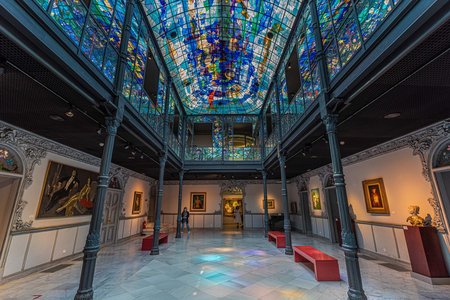
MUSEUM OF ART NOUVEAU AND ART DÉCO. CASA LIS
Casa Lis is the most important modernist building in Salamanca. Since 1995, it has housed the Art Nouveau and Art Deco Museum. It was built by the architect Joaquín de Vargas Aguirre from Jerez as the residence of Miguel de Lis, a wealthy industrialist from Salamanca.
The north facade, facing Gibraltar Street, is one of the few clearly modernist examples in the city, where stone and brick comb...
View details
The north facade, facing Gibraltar Street, is one of the few clearly modernist examples in the city, where stone and brick comb...
2
CUEVA DE SALAMANCA
The Cave of Salamanca is one of the city's most evocative corners, a place where history and legend have intertwined for centuries. In this corner, visitors discover the remains of the ancient medieval church of San Cebrián, whose crypt still preserves the mysterious atmosphere that has enveloped the place for centuries.
Next to it stands a section of the wall that protected the city in the Mid...
View details
Next to it stands a section of the wall that protected the city in the Mid...
3
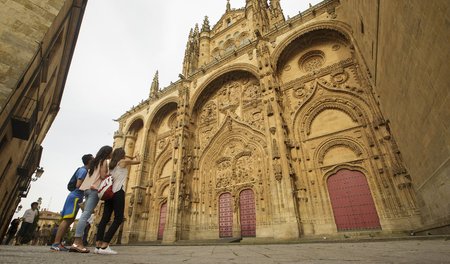
SALAMANCA CATHEDRAL
The Cathedral of Salamanca is a fundamental landmark in the historical evolution of the city. The coexistence of two temples -the Old Cathedral and the New Cathedral- attached to each other, is something exceptional, showing visitors an important part of the evolution of Western art over approximately six hundred years.
The Old Cathedral, dedicated to Santa María de la Sede, is a magnifi...
4
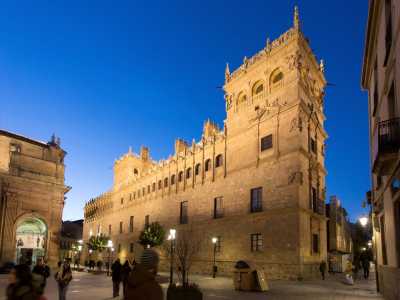
Palacio de Monterrey
Located in the Plaza de Monterrey, a few meters from Salamanca's Plaza Mayor, the Palace of Monterrey stands as one of the great references of the Plateresque style and one of the most representative constructions of the Spanish Renaissance. Its construction began in 1539 under the direction of Rodrigo Gil de Hontañón, commissioned by Don Alonso de Zúñiga y Acevedo, third Count of Monterrey. In 17...
View details
5
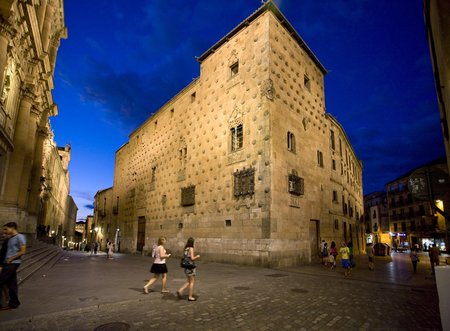
HOUSE OF SHELLS
The House of Shells is a remarkable stately mansion built during the time of the Catholic Monarchs, where late Gothic forms, Mudéjar art, and the early influences of the Renaissance coexist in balance. Its construction began at the end of the 15th century at the initiative of Rodrigo Maldonado de Talavera and was subsequently completed by his son, Rodrigo Arias Maldonado.
The building owes its ...
View details
The building owes its ...
6
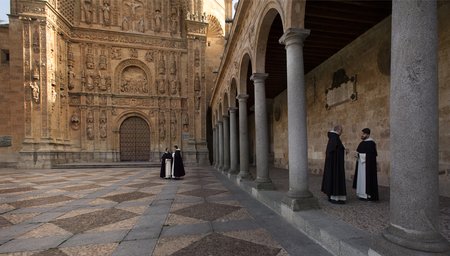
CONVENT OF SAN ESTEBAN
The Convent of San Esteban in Salamanca is one of the most outstanding examples of Spanish religious architecture. Founded in the 13th century, the current building was erected mainly between the 15th and 16th centuries. Its architecture integrates Gothic, Renaissance, and Baroque elements, although its most distinctive feature is the Plateresque style, visible in its famous facade, conceived as a...
View details
7
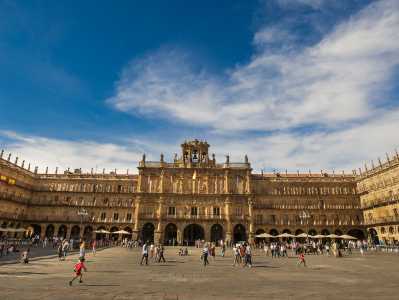
PLAZA MAYOR
Salamanca's Plaza Mayor is one of the great ensembles of Spanish Baroque and the city's main monumental space. Its construction took place between 1729 and 1755 with the aim of creating a large public square of civic and representative character.
The project was initiated by Alberto de Churriguera, who conceived a practically square-plan porticoed square. After his departure, the works were cul...
View details
The project was initiated by Alberto de Churriguera, who conceived a practically square-plan porticoed square. After his departure, the works were cul...
8
PLAZA DE ANAYA
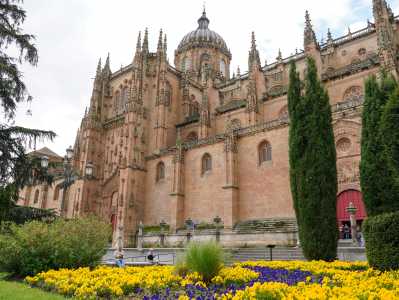
Anaya Square is one of Salamanca's most emblematic spots and a must-visit for anyone visiting the city. Its origin dates back to the Peninsular War, when French General Thiebault ordered the demolition of the cluster of houses that extended between the facade of the Colegio Mayor de Anaya and the north atrium of the Cathedral. On the north side of the square, opposite the New Cathedral, stands the...
View details
9
COURTYARD OF THE MINOR SCHOOLS OF THE UNIVERSITY OF SALAMANCA
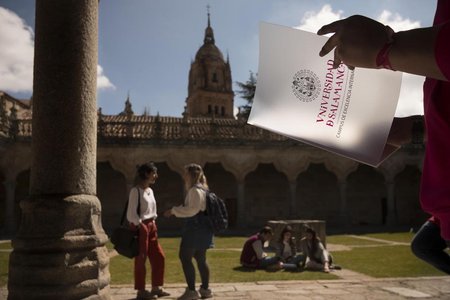
The Courtyard of the Minor Schools is one of the most evocative and tranquil corners of Salamanca's university complex. Built at the beginning of the 16th century, its classrooms taught basic subjects such as grammar and logic, before students moved on to higher studies.
Upon entering -presided over by a beautiful Plateresque façade featuring the symbols of Emperor Charles V and the university'...
View details
Upon entering -presided over by a beautiful Plateresque façade featuring the symbols of Emperor Charles V and the university'...
10
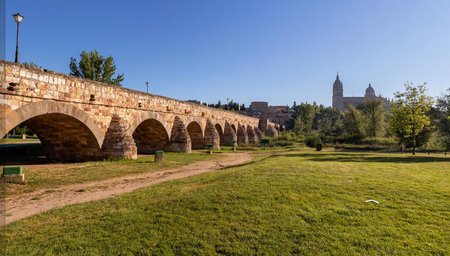
ROMAN BRIDGE
The Roman Bridge is one of the most emblematic constructions of the city. Situated over the Tormes river, this bridge was the only access route to Salamanca from the south until the beginning of the 20th century. It is believed to have been built in the 1st century AD as part of the infrastructures of the Vía de la Plata (Silver Route), a route that connected Mérida with Astorga. Throughout the ce...
View details