Saint Teresa's Route
HOUSE OF SAINT TERESA
The House of Santa Teresa is located on Crespo Rascón street, and its origin dates back to the late 15th century. Its sober and austere facade features a large arched doorway formed by large voussoirs and a window flanked by two coats of arms.
It was in this place that Saint Teresa of Jesus settled on October 31, 1570, the eve of All Saints' Day, to carry out her seventh foundation of Discalced Carmelites. Here she experienced the famous “night of souls” and found inspiration to write her...
View details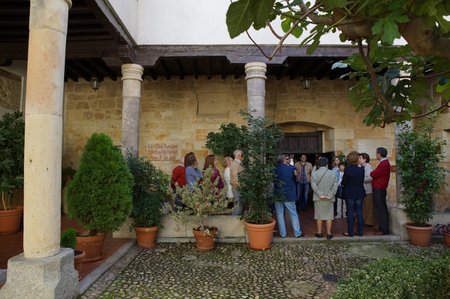
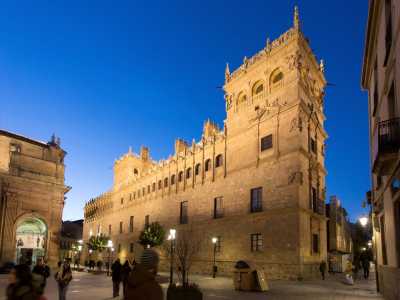
Palacio de Monterrey
Located in the Plaza de Monterrey, a few meters from Salamanca's Plaza Mayor, the Palace of Monterrey stands as one of the great references of the Plateresque style and one of the most representative constructions of the Spanish Renaissance. Its construction began in 1539 under the direction of Rodrigo Gil de Hontañón, commissioned by Don Alonso de Zúñiga y Acevedo, third Count of Monterrey. In 1711, the palace became part of the heritage of the House of Alba.
The elegant Plateresque decorat...
Calle Compañía
Calle Compañía, in Salamanca, is a pedestrian thoroughfare famous for its architectural richness and historical significance.
View details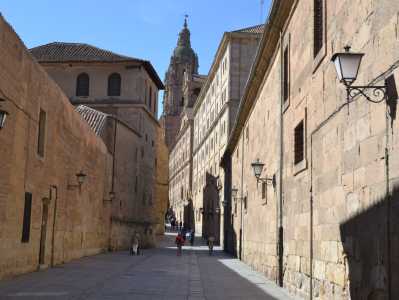
CHURCH OF LA CLERECÍA AND PONTIFICAL UNIVERSITY
The imposing complex formed by the Church of La Clerecía and the Pontifical University of Salamanca has its origin in the Royal College of the Holy Spirit, founded in the 17th century at the initiative of Philip III and Margaret of Austria for the Society of Jesus, with the purpose of training missionaries.
Its construction lasted for more than one hundred and fifty years, beginning under the direction of Juan Gómez de Mora and finishing in the 18th century with the intervention of Andr...
View details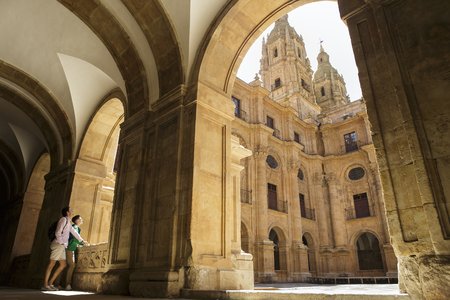
Palominos Street
Street with beautiful views of the Clerecía
View details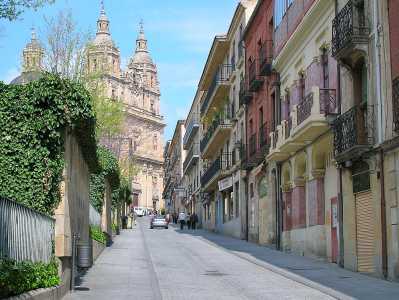
Plaza del Concilio de Trento
The Plaza del Concilio de Trento is a public space notable for its direct connection to the Convent of San Esteban.
View details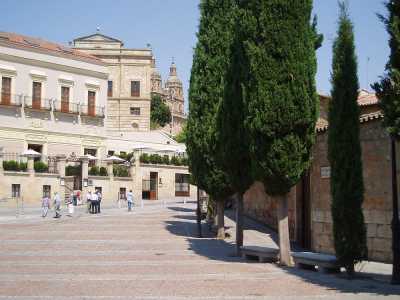
CONVENT OF SAN ESTEBAN
The Convent of San Esteban in Salamanca is one of the most outstanding examples of Spanish religious architecture. Founded in the 13th century, the current building was erected mainly between the 15th and 16th centuries. Its architecture integrates Gothic, Renaissance, and Baroque elements, although its most distinctive feature is the Plateresque style, visible in its famous facade, conceived as a large altarpiece in the center of which the martyrdom of Saint Stephen is depicted. Inside, highlig...
View details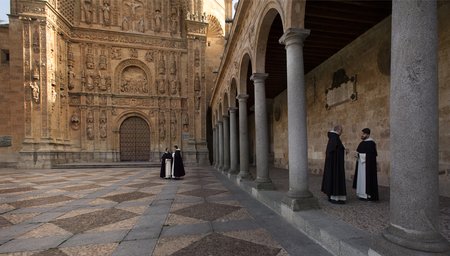
Plaza de Colón
Salamanca's Plaza de Colón is a central and highly significant hub within the city, serving as a vital link between its modern area and the historic quarter.
View details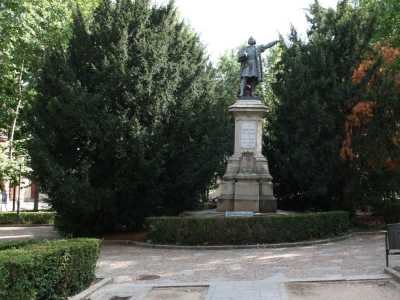
Calle San Pablo
Calle San Pablo is one of Salamanca's main arteries, boasting a history as rich and complex as the city itself. Unlike other streets with a simpler origin, San Pablo Street is actually the union of several segments that had distinct names and functions throughout the centuries.
View details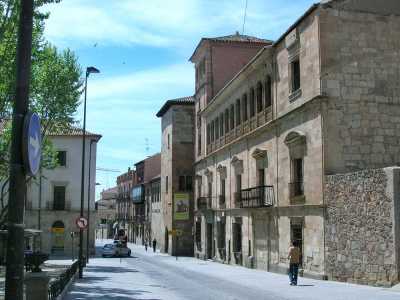
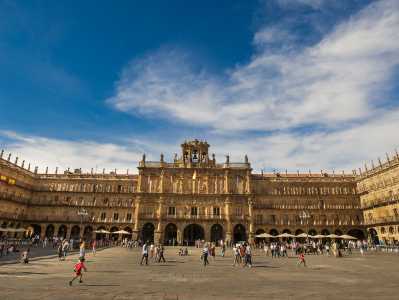
PLAZA MAYOR
Salamanca's Plaza Mayor is one of the great ensembles of Spanish Baroque and the city's main monumental space. Its construction took place between 1729 and 1755 with the aim of creating a large public square of civic and representative character.
The project was initiated by Alberto de Churriguera, who conceived a practically square-plan porticoed square. After his departure, the works were culminated by Andrés García de Quiñones, responsible for the completion of the complex and of element...
View details